Search

Showing posts with label paleontology. Show all posts

Friday, April 22, 2022

Pterosaurs May Have Had Brightly Colored Feathers, Exquisite Fossil Reveals

An amazingly well-preserved fossil suggests the common ancestor of dinosaurs and pterosaurs also had some type of feather or feather precursor.

Artist reconstruction of Tupandactylus imperator. Credit: Bob Nicholls (CC BY)

Friday, April 8, 2022

A hole in a Triceratops named Big John probably came from combat

The puncture adds to evidence that the three-horned dinosaurs battled each other.

The largest known Triceratops features a hole in its bony frill that suggests the dinosaur, called Big John, fought with its peers. F. BACCHIA/ZOIC LLC

Thursday, December 30, 2021

Scientists find fossil of largest arthropod to ever live, a car-size millipede

They were likely one of the biggest animals living on Earth at the time.

The fossilized exoskeleton fragment from the giant millipede ancestor Arthropleura, recently found in the U.K. (Image credit: Neil Davies)

Friday, February 1, 2019

Gunung Padang: The Oldest Pyramid On Earth

With pieces that might be 25,000 years old, the pyramid at Gunung Padang could be evidence of an advanced civilization that predates any currently known to the world.


The Gunung Padang site. Credit: Wikimedia Commons

Saturday, July 18, 2015

Jurassic saw fastest mammal evolution

Early mammals lived alongside the dinosaurs during the Mesozoic era (252-66 million years ago). They were once thought to be exclusively small nocturnal insect-eaters, but fossil discoveries of the past decade – particularly from China and South America – have shown that they developed diverse adaptations for feeding and locomotion, including gliding, digging, and swimming.

Source: Oxford University

Wednesday, July 4, 2012

An exceptionally preserved young dinosaur with feathers from Germany

A new species of feathered dinosaur discovered in southern Germany is further changing the perception of how predatory dinosaurs looked. The fossil of Sciurumimus albersdoerferi, which lived about 150 million years ago, provides the first evidence of feathered theropod dinosaurs that are not closely related to birds. The fossil is described in a paper published in the Proceedings of the National Academy of Sciences.

Skull of Sciurumimus albersdoerferi (photo taken at Fossil Show, Munich). Credit: Ghedo / Wikimedia Commons

Wednesday, June 6, 2012

Unexpected crash diet for dinosaurs

Scientists have developed a new technique to accurately measure the weight and size of dinosaurs and discovered they are not as heavy as previously thought.

University of Manchester biologists used lasers to measure the minimum amount of skin required to wrap around the skeletons of modern-day mammals, including reindeer, polar bears, giraffes and elephants.

Tuesday, May 8, 2012

Greenhouse gas dinosaurs

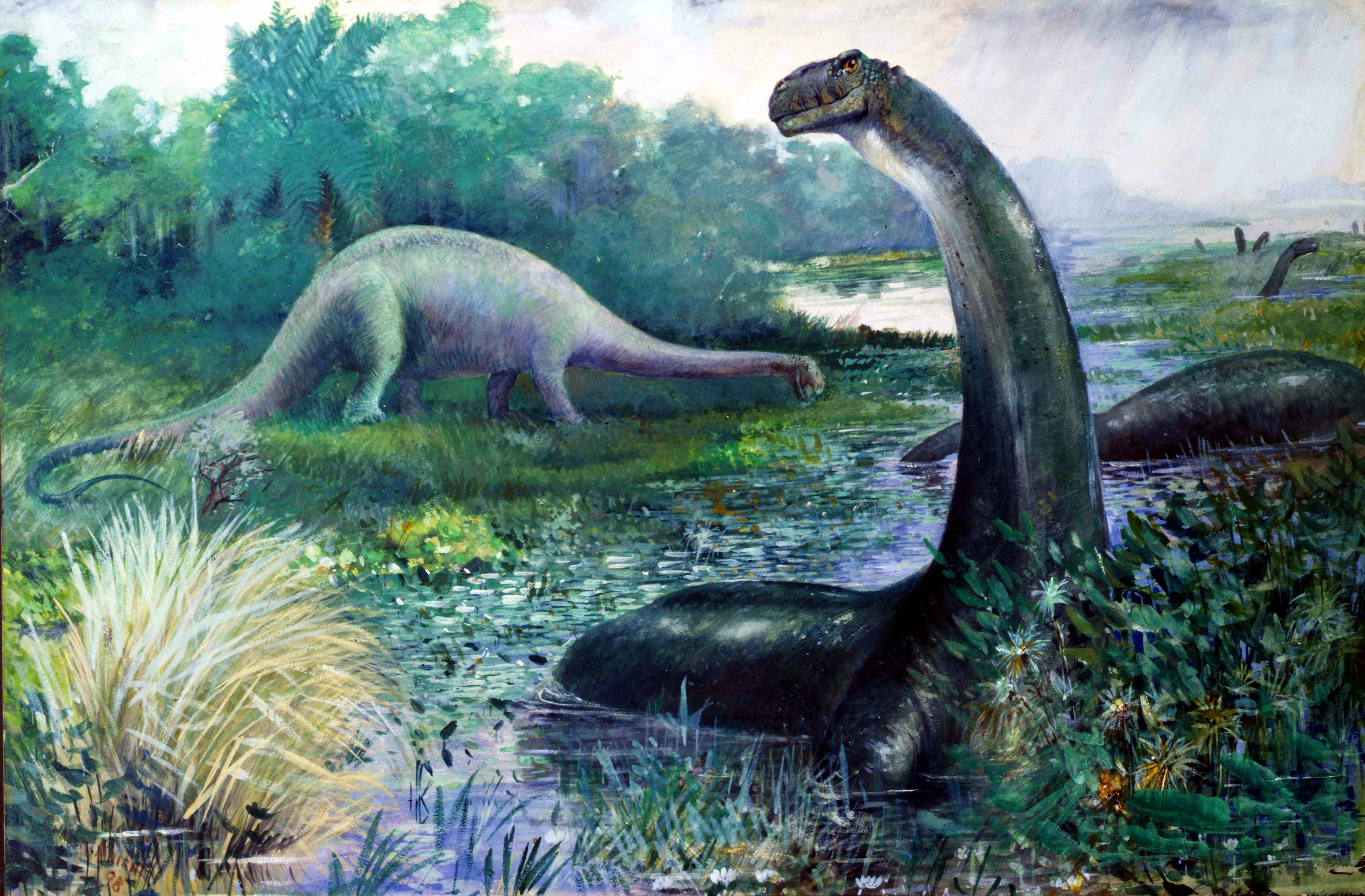
Need to heat your planet? Install some dinosaurs. The biggest plant-eating dinosaurs pumped out huge amounts of greenhouse gas, helping to keep Earth toasty warm, according to new calculations.

Swamp-bound 'Brontosaurus' (now Apatosaurus), painted in 1897 by Knight, with static terrestrial Diplodocus in background

Monday, May 7, 2012

Jurassic Pain: Giant “Flea-Like” Insects Plagued Dinosaurs

It takes a gutsy insect to sneak up on a huge dinosaur while it sleeps, crawl onto its soft underbelly and give it a bite that might have felt like a needle going in – but giant “flea-like” animals, possibly the oldest of their type ever discovered, probably did just that.

This ancient "flea-like" insect, Pseudopulex jurassicus, lived 165 million years ago. It used a long proboscis to feed on the blood of dinosaurs, with a bite that would have been unusually painful. Credit: Wang Cheng / Oregon State University

Wednesday, October 3, 2007

New duck-billed dinosaur was a 'chewing machine'

Prehistoric plants had a lot to fear from Gryposaurus monumentensis – with around 800 teeth inside its massive jaws, the 9-metre-long (30 feet) duck-billed dinosaur could have made a snack of tree branches as well as foliage. The creature lived in what is now southern Utah, some 75 million years ago.

The duck-billed dinosaur was 9 metres in length (30 feet), and lived around 75 million years ago in the late Cretaceous period (Illustration: Larry Felder)