 |
| Hot and cold: artist's impression of the exoplanet WASP-121b and its host star. (Courtesy: NASA, ESA, and G Bacon (STSci)) |
Showing posts with label Hot Jupiters. Show all posts
Showing posts with label Hot Jupiters. Show all posts
Saturday, March 19, 2022
Liquid metal, ruby and sapphire could rain down on huge exoplanet

Friday, June 29, 2012
How to lose a thousand tons of atmosphere per second
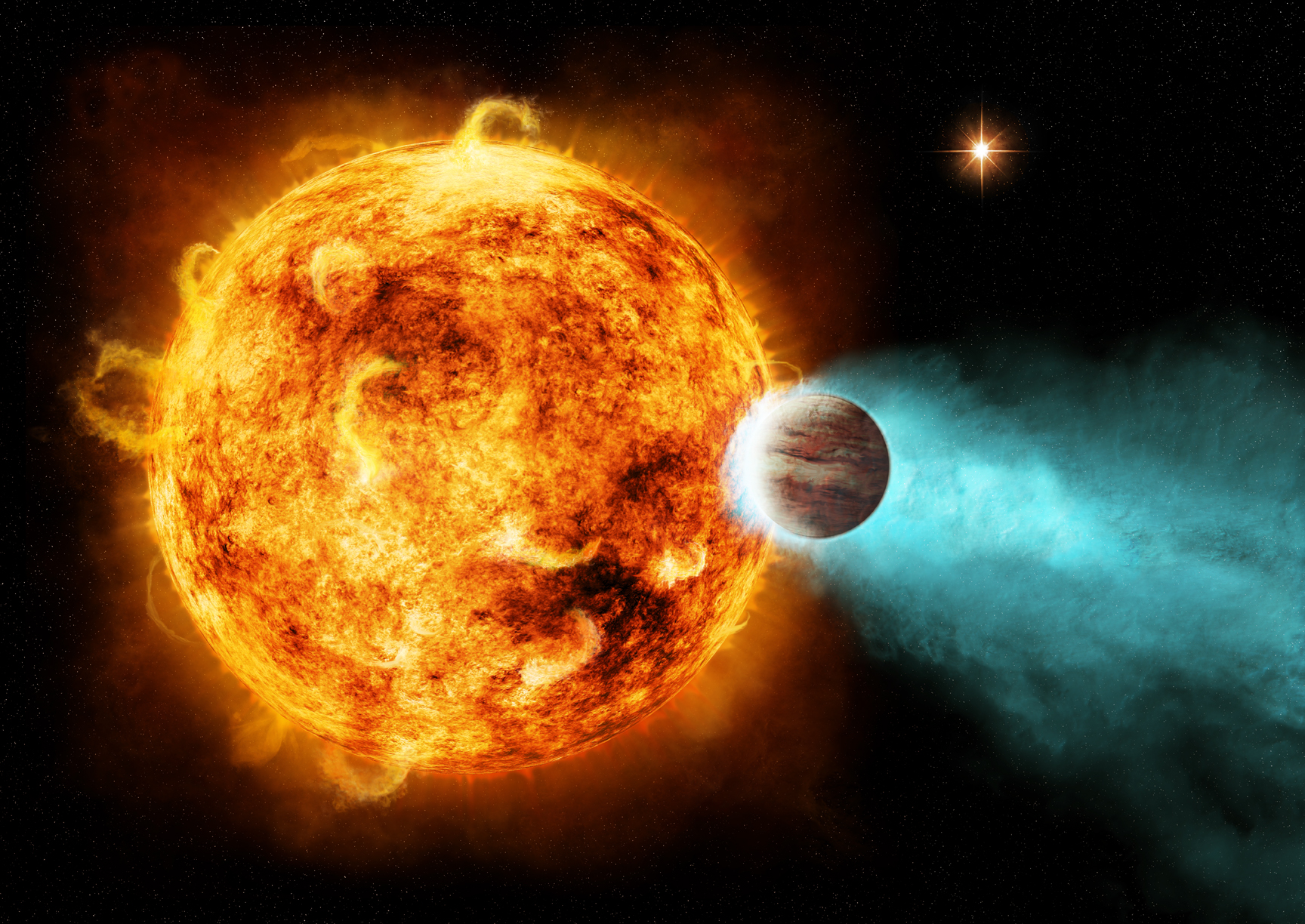
Astronomers using the NASA/ESA Hubble Space Telescope have seen dramatic changes in the upper atmosphere of a faraway planet. Just after a violent flare on its parent star bathed it in intense X-ray radiation, the planet’s atmosphere gave off a powerful burst of evaporation. The observations give a tantalising glimpse of the changing climates and weather on planets outside our Solar System.

|
| This artist’s impression shows exoplanet HD 189733b, as it passes in front of its parent star, called HD 189733A. Hubble’s instruments observed the system in 2010, and in 2011 following a large flare from the star (depicted in the image). Following the flare, Hubble observed the planet’s atmosphere evaporating at a rate of over 1000 tonnes per second. In this picture, the surface of the star, which is around 80% the mass of the Sun, is based on observations of the Sun from the Solar Dynamics Observatory. Credit: NASA, ESA, L. Calçada |
Tau Boötis b, a six Jupiter-mass planet orbiting very close to its parent star
For the first time a clever new technique has allowed astronomers to study the atmosphere of an exoplanet in detail — even though it does not pass in front of its parent star. An international team has used ESO’s Very Large Telescope to directly catch the faint glow from the planet Tau Boötis b. They have studied the planet’s atmosphere and measured its orbit and mass precisely for the first time — in the process solving a 15-year old problem. Surprisingly, the team also finds that the planet’s atmosphere seems to be cooler higher up, the opposite of what was expected. The results were published in the 28 June 2012 issue of the journal Nature.
 |
| This artist’s impression shows the exoplanet Tau Boötis b. This was one of the first exoplanets to be discovered back in 1996, and it is still one of the closest planetary systems known to date. Astronomers using ESO’s Very Large Telescope have now caught and studied the faint light from the planet Tau Boötis b for the first time. By employing a clever observational trick the team find that the planet’s atmosphere seems to be cooler higher up, the opposite of what was expected. Credit: ESO/L. Calçada |
Saturday, May 19, 2012
Superflares from Sun-like stars
Stars that are just like our Sun have flares more than a million times more energetic than the biggest flare ever seen on the Sun. The Kepler satellite has allowed these superflares to be studied in detail for the first time.
 |
| The sun released a M1.7 class flare associated with a prominence eruption on April, 16, 2012. The flares produced by our Sun are from 10 to 10 million times less powerful than the superflares unleashed by other solar-type stars, according to a recent paper published on Nature. Credit: NASA/SDO/AIA |
Tuesday, May 15, 2012
Hot Jupiters may disrupt the formation of Earth-like planets
In the search for Earth-like planets, it is helpful to look for clues and patterns that can help scientist narrow down the types of systems where potentially habitable planets are likely to be discovered. New research from a team including Carnegie’s Alan Boss narrows down the search for Earth-like planets near Jupiter-like planets. Their work indicates that the early post-formation movements of hot-Jupiter planets probably disrupt the formation of Earth-like planets.
 |
| Jupiter and its four planet-size moons, called the Galilean satellites photographed and assembled into a collage by NASA. Credit: NASA/JPL |
Wednesday, May 9, 2012
“Hot Jupiter-type” planets are most likely to be alone in their systems, according to research by a University of Florida astronomer and others, made public on May 7 2012.
 |
| This artist's representation shows the CoRoT-2 system, which is found about 880 light years from Earth. The system, which is estimated to be between 100 and 300 million years old, contains a star and a planet in close orbit around it. The separation between the star and the planet is only three percent of the distance between the Earth and the Sun, causing some exotic effects not seen in our solar system. The illustration shows the material, in blue, being stripped off the planet as X-rays from the star pummel the planet. Credit: NASA/CXC/M.Weiss |