The 304 Å channel of the SDO/AIA instrument, which traces mainly He II ions, allows to see the Sun's chromosphere and the solar transition region. The chromosphere, a layer normally invisible, only about 2,000 km deep, situated just above the brighter and denser photosphere, is related to phenomena such as prominences, filaments, spicules, plages. The transition region is a layer even thinner, placed between the chromosphere and the corona, in which the temperature rises dramatically, for reasons not yet fully understood, from about 25,000 to about 1-2 million K. In the images shown below, Venus crosses the Sun's disc, over this ocean of seething plasma excited by powerful magnetic fields.
Finally, a necessary explanation for the benefit of readers. I could add here a movie of the whole transit seen in this wavelength (there are several on-line). I preferred, however, a series of static images, even though the page loading is now very slow. But I thought that the transit of Venus is a phenomenon so beautiful and rare that it is worth waiting a little longer, to be able to observe quietly and clearly every step of the event.
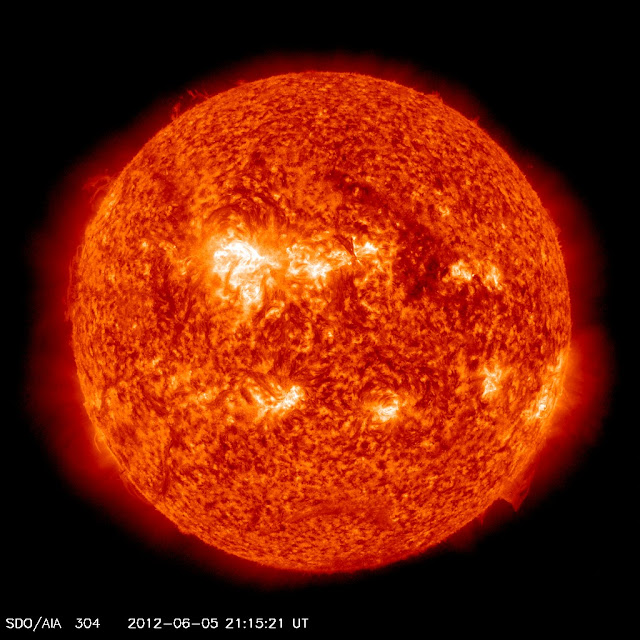 |
| This and the following images are courtesy of NASA/SDO and the AIA, EVE, and HMI science teams |


